My turmeric has arrived. No ethnic cooking with these 300 capsules of East Indian spice, however, because they're brain food for me. Every so often I come across research so compelling that I shut down the word processor and search the web for the best price on a priceless new product. And 150 days worth of turmeric for $9.00 at www.puritan.com seems like a bargain. Here's why.
Alzheimer's disease causes the accumulation of an abnormal protein called beta amyloid (Abeta) in the brain. Great glumps of Abeta destroy brain cells, perhaps by setting off an inflammatory process in much the same way that cholesterol deposits lead to the destruction of blood vessel walls. Anti-amyloid agents theoretically could prevent this degenerative process.
Enter curcumin or turmeric, the yellow curry pigment which is already known to possess antioxidant and anti-inflammatory properties. Scientists working on mouse brains (both inside and outside the mouse) found that curcumin was a potent inhibitor of Abeta aggregation. In other words, a dash of spice on a mucked-up mouse brain prevented little Abeta clumps from growing into big nasty plaques. Furthermore, Tg2576 mice--bred to be particularly susceptible to senility--with advanced amyloid guck in their brains actually reversed their Abeta plaques when Indian curry replaced their standard American chow.
The authors of this UCLA study published a few months ago in the Journal of Biological Chemistry concluded: "These data suggest that low dose curcumin effectively disaggregates Abeta... supporting the rationale for curcumin use in clinical trials preventing or treating AD." They are currently undertaking just that to see if curcumin can improve mental status in patients already affected by Alzheimer's disease.
Showing posts with label Herbs. Show all posts
Showing posts with label Herbs. Show all posts
Saturday, November 10, 2007


Tuesday, October 30, 2007
Nutmeg
I never think about nutmeg except briefly at Thanksgiving to once again note that I have none on my shelf when it's time to make pumpkin pie. Thanks to Dr. Jacob Schor, however, I must reconsider my nutmegless status in the interest of keeping my marbles intact.
This Denver naturopath is a wealth of knowledge about natural remedies of the herbal variety and their value in keeping body and mind intact. He muses over nutmeg whilst grinding same for his holiday recipes, and he includes both recipes and scientific abstracts in his current newsletter.
Of particular interest to me in my never-ending quest for brain protective strategies is news from India about the acetylcholinesterase inhibiting qualities of this spice. Acetylcholine is a neurotransmitter which allows neurons in charge of memory functions to communicate with one another in order to both make 'em and keep 'em (memories that is).* Acetylcholinesterase is the enzyme that breaks down acetylcholine, and the inhibitor of same allows acetylcholine to work longer in the gap between memory-preserving neurons.
That is how current medications for Alzheimer's disease, including Aricept and Exelon, work. London pharmacologists screened a number of Indian herbs for this activity and found that even weensy bits of nutmeg extract diminished the activity of acetylcholinesterase inhibitor by 50%.
I don't even know if I really like nutmeg between never having it in the cupboard and not having a very discerning palate. I think I could learn to like it, however, if it supports my aging brain!
_____
*This is why anticholinergic medications like benadryl and other antihistamines (used for allergies and sleep), oxybutynin (used for bladder control), and amitryptilline (used for sleep and chronic pain control) can befuddle susceptible older persons and should not be used.
This Denver naturopath is a wealth of knowledge about natural remedies of the herbal variety and their value in keeping body and mind intact. He muses over nutmeg whilst grinding same for his holiday recipes, and he includes both recipes and scientific abstracts in his current newsletter.
Of particular interest to me in my never-ending quest for brain protective strategies is news from India about the acetylcholinesterase inhibiting qualities of this spice. Acetylcholine is a neurotransmitter which allows neurons in charge of memory functions to communicate with one another in order to both make 'em and keep 'em (memories that is).* Acetylcholinesterase is the enzyme that breaks down acetylcholine, and the inhibitor of same allows acetylcholine to work longer in the gap between memory-preserving neurons.
That is how current medications for Alzheimer's disease, including Aricept and Exelon, work. London pharmacologists screened a number of Indian herbs for this activity and found that even weensy bits of nutmeg extract diminished the activity of acetylcholinesterase inhibitor by 50%.
I don't even know if I really like nutmeg between never having it in the cupboard and not having a very discerning palate. I think I could learn to like it, however, if it supports my aging brain!
_____
*This is why anticholinergic medications like benadryl and other antihistamines (used for allergies and sleep), oxybutynin (used for bladder control), and amitryptilline (used for sleep and chronic pain control) can befuddle susceptible older persons and should not be used.
Thursday, August 10, 2006
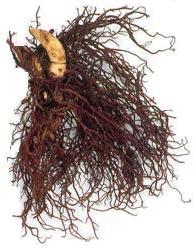
Rooting for coolness?
Investigators from the Mayo Clinic set out to determine whether menopausal flashers were better off using black cohosh root to treat the heat compared with no herbs at all.
132 hot women were assigned to try the supplement for 4 weeks followed by a month on fake cohosh. They all kept daily diaries (covered in hot pink no doubt) in which they scored each flash from 1-4 for severity. Total points for the fourth treatment and placebo weeks were compared to a baseline week prior to the study's start.
The average decrease in hot flash score was 20% for the week on black cohosh vs. 27% for the week on fake cohosh. This extraordinary placebo response has been noted in many other menopausal symptom treatment trials. Investigators concluded that black cohosh does not beat the postmenopausal heat.
I had one patient develop hepatitis as a result of using black cohosh. This side effect is uncommon but has been previously reported.
Subscribe to:
Posts (Atom)


