Not often that one gets to gain height as an adult instead of weight. But since I started neuro-kinetics therapy--a one-of-a-kind program here in Denver--to unravel the degenerative scoliosis that plagues my lower back, that's one of my goals.
Therapist Bob Gaas claims that these aging curves are more about muscle spasm and scarring then about permanent spinal changes. He hopes this program will not only free me from stiff-woman syndrome--so tightly wound was I that I could scarcely step into my jeans in the a.m.--but also it will give me back a significant portion of the 1&1/2 inches of height I've lost through the years.
Indeed, I grew some after just the first visit. Better yet, early morning jean-stepping is not a problem. And best of all, I'm no longer the only lady in the Jazzercise class who can't shake her hips!
Friday, March 30, 2007


The D-lemma
If you've been reading my newsletters, you know that I have picked up D passion. This vitamin's star is rising not only with respect to its importance to bone density but also its anti-cancer properties. Worries about D toxicity are dropping off; many experts recommend as much as 4,000 units per day during winter months in northern climes. Some UK health experts also recommend a new public health policy of daily sunscreenless interludes outside when there's sun to be had.*
Here in sunny Denver, some of my pasty white patients haven't heard the news. In the last week alone, I checked D levels on two middle-aged ladies in search of bone strength. Their levels were virtually non-existent!
Are you a visual learner? Check out the cancer incidence maps at
Sunlight, Nutrition, and Health Resource Center.
Got sunshine? Got D? Then you got cancer protection.
_____
*Sunlightrobbery
Thursday, March 29, 2007
The Pain Matrix
I find that a challenging yoga class brings a little thrill of fear to me which is not necessarily a pleasant sensation. A new study utilizing fancy brain-imaging techniques may explain the connection.
Researchers at the University of Manchester used PET scan imaging to see what parts of the brain lit up when people ached in their arthritic old knees. This technique involves injecting a person with a tagged sugar molecule called F-fluorodeoxyglucose or FDG. FDG is concentrated in neurons as they suck up sugar while at work reacting to the task at hand.
Neurobiologists already know which brain pathways activate when volunteers are pinched or kicked or however it is that researchers induce experimental pain. This same 'pain matrix' is also activated by arthritic pain. These UK scientists were surprised, however, to find that pain from degenerative joints "was associated with increased activity in the cingulate cortex, the thalamus, and the amygdala. These areas are involved in the processing of fear, emotions, and in aversive conditioning."
So if yoga induces pain in degenerating knee joints--and despite all that soothing patter from the instructor, I find it often does--aging yoginis might feel fear.
Friday, March 23, 2007
Silent brain infarctions
Clinically identified stroke represents the tip of the iceberg in terms of cerebral vascular disease by at least an order of magnitude...It is hard to believe, however, that loss of brain tissue should go without consequences. The brain may reorganize functional networks to adapt to lesions and recover function. But with each subsequent stroke, the capacity to do so is diminished.
--Brian J. Murray, MD
Scary new news on SBIs--one-fourth of persons with obstructive sleep apnea (the bedmate who keeps you awake as you wait for him to take his next breath) were found in a Japanese study to have evidence of extensive silent strokes on MRI imaging.
For more information on diagnosing tiny strokes and their devastating consequences, see
The white matter matter.
Thursday, March 22, 2007
Tuesday, March 20, 2007
(Soy) Nuts to you!
Too bad soy nuts are so disgusting. Previous research shows they squelch the heat and support the bones. A new study suggests that women on the road to diabetes improve their disordered metabolism by substituting soy nuts for meat protein.
Soy nut meals decreased insulin resistance and fasting blood sugar. Probably all the chewing involved in getting through the meal without choking.
Soy nut meals decreased insulin resistance and fasting blood sugar. Probably all the chewing involved in getting through the meal without choking.
Monday, March 19, 2007
HRT: NAMS is singing a new tune
In this day and age, the life span of any position statement is a maximum of 2 or 3 years. In the face of so much new information, we felt an update was due.
--Dr. Wolf Utian, Executive director of the North American Menopause Society
And their new position is that the benefits of hormone therapy outweigh its risks in healthy perimenopausal and early postmenopausal women with menopause-related symptoms and a low baseline risk of stroke.
--Dr. Wolf Utian, Executive director of the North American Menopause Society
And their new position is that the benefits of hormone therapy outweigh its risks in healthy perimenopausal and early postmenopausal women with menopause-related symptoms and a low baseline risk of stroke.
Saturday, March 17, 2007
"Oldest old support ratio"
It may take a village to raise a child, but don't forget that part of the village needed to care for the frail elderly.
Swiss investigators, noting that resources to care for the oldest old are increasingly scarce, set out to quantify the problem. They developed a parameter called the oldest old support ratio, defined as the ratio of people aged 50-75 to those aged 85 years and older. This number not only reflects the demographic shift of populations to the older range, but also--as I can personally attest to--the number of aging children in charge of their frail parents.
So what's the scoop on the oldest old support ration in Switzerland? While it stood at 139.7 in 1890 (scads of middle-aged helpers to a smattering of little old people), it had fallen to 13.4 by 2003. Dr. Francis Herrmann and company predict that this ration will fall to around 4 in both Switzerland and the US by 2050.
By my calculations, that won't be near enough helpers and resources to care for 99 year old me.
Friday, March 16, 2007
An Aged Athlete
From a simpler time, when old was old, and physically fit was not (old that is):
An old-time champion pedestrian, whose record 30 or 40 years ago aroused the country, has recently at the age of nearly 70 performed the feat of walking from Philadelphia to New York, a distance of 96 miles, in a little over 23 hours and finished the task in excellent physical condition. This is a good example of the fact that the physical organization of man need not necessarily go to pieces before the allotted three score and ten, when, according to some, the system is worn out and useless. Of course, this man is an exceoptional case, but he shows what the possibilities are, and probably a great man other individuals of as great age could do likewise.
----JAMA, June 23, 1906
Sunday, March 11, 2007
Like fertilizer on a sparse lawn...
...a chemical enticement encourages the skin to fill in hair-growing structures.*
---RJ Davenport
Dr. Davenport goes on to explain why hair gets increasingly pathetic with age. People are born with all the hair follicles they'll ever have. Over time, hair follicle performance 'falters,' and these hair-replenishing structures spend more time resting than growing. Follicles, along with every thing else that's fresh and young in humans, shrink with age.
Is there good news? A molecule called beta-catenin can induce new hair follicles, at least in mice. Dr. Davenport feels that this research may hold hope that hair can be saved as we age.
_____
*R. J. Davenport, Hair Trigger. Sci. Aging Knowl. Environ. 2005 (27), nf54 (2005)
Saturday, March 03, 2007
Measuring up on the SSWO score
Fraility in the elderly is all about loss--stamina, weight, muscle mass, energy--all of it yesterday's news as vibrant 70-somethings shrivel into tiny 80-somethings. Dutch researchers examined whether 17 weeks of exercise and micronutrient supplementation could up the SSWO (scale of subjective well-being for older persons) scores for scores of frail, old Dutchmen and women.
Their conclusion? No, it's not enough, or perhaps too little too late. They did find, however, a strong correlation between deficiencies in vitamins B6, D, and folate and crazy low SSWO scores.
In addition, they theorized that the lack of improvement in SSWO scores might reflect that subjective assessments of well-being are stable and relatively insensitive to actual changes in health status. In other words, even though the interventions may have changed the participants health for the better, these little, old people had a fixed notion of how they felt at this stage of the game, and self-appraisals are more about attitude than fitness and nutritional status.
Friday, February 23, 2007
D upright vitamin for the old folks
I'm not sure when my mom last got out in the sun. She, like other housebound seniors, is at high risk for D vitamin deficiency. A Harvard study recently published in the Journal of the American Geriatric Society confirms that extra D--800 or more units/day--can significantly prevent the elderly from going to ground.
.
The investigators randomized a group of old old folks (average age 89) to various levels of D supplementation. Defining a fall as "a sudden, unintentional change in position causing a resident to fall to the ground," they checked out which doddery test subject experienced such sudden changes as a function of their D intake.
While daily D doses of 400 units or less didn't make a bit of D-ference with respect to unintentional position changes, those residents assigned to the 800 unit group were 72% less likely to end up on the ground over 5 months compared to their colleagues.
While D alone will not necessarily keep the old perpendicular to the floor, the vitamin does promote muscle strength as well as bone strength and should be considered an important nutrtional supplement for the elderly.
Changing thresholds
In the past few years, lab work that used to be 'normal' is now redefined risky. In particular, fasting blood sugar was considered normal up to 110, but the new acceptable cut-off has dropped to 99. Fasting blood sugars 100-125 are now considered 'prediabetes' or 'impaired fasting glucose (IFG).'
This down-graded normal threshold is based on population studies that show risk of diabetes and heart disease rises significantly in persons with these low level elevations. A new study from the State University of New York at Buffalo confirms that prediabetes, like prehypertension (see previous post) is definitely pretrouble.
Investigators there looked at women who developed abnormal fasting blood sugars over a six year period while participating in the Western New York Health Study. Blood samples collected and frozen at the start of the study were pulled out for re-examination after the IFG diagnosis was made, comparing these results with those from control subjects who did not become prediabetic. The samples were checked for endothelial markers--tests that indicate an active inflammatory process occurring in the blood vessel wall which, in turn, greatly increases the risk of coronary artery disease.
Not only did prediabetics have significantly elevated endothelial markers before they ever manifested any blood sugar abnormality, the women with elevated fasting sugars had more abnormal baseline tests of blood vessel inflammation than did the prediabetic men. The researchers theorized that this may explain why diabetic women are known to have a higher risk of heart disease than diabetic men.
Tuesday, February 20, 2007
Stroke risk for postmenopausal women
The increased risk of stroke for those women of the Women's Health Initiative Study on hormone therapy vs. those on none was 55%. But here's stroke news from the WHI that never made headline news:
Those women among over 60,000 studied over 7 years who had pre-hypertension were nearly twice as likely to experience a stroke compared with their colleagues who had ideal blood pressure less than 120/80. Pre-hypertension is also known as 'high normal' or 'borderline high' or 'sort'a okay' blood pressure from 120 to 139 systolic and 80-90 diastolic.
No more 'not bad/not good' dismissive comments from me on these pre-hypertensive readings. I'm not okay with these 'not-okay' BPs from now on.
Friday, December 15, 2006
Not forever, not for everybody
Hormones again in headline news, this time newsworthy by the the benefits of their absence.
Recent analysis of cancer incidence statistics for 2003 show a significant 7% drop in breast cancer cases for this particular year, the first full year of data following the abrupt termination of the Women's Health Initiative. Millions of women went off HRT as a result of the WHI data, and within a year, breast health improved.
While doctors acknowledge that cancers take years to form, they theorize that cancer cases may have decreased as itty bitty cancers that were forming in response to estrogenic stimulation shrank or disappeared. Indeed, the biggest decline was in tumors whose growth is fueled by estrogen--no estrogen, no support of tumor growth.
This news emphasizes the importance of individual decision-making in medical care. Any big decision--and to take hormones or not is a huge one--requires weighing many factors including personal and family health history, current symptoms, individual beliefs and worst fears, and future health goals.
Estrogen stimulates cell growth and repair. That is a good thing for neurons, muscle cells, osteocytes (bone), connective tissue, and healthy blood vessels. That is a bad thing for breast and uterine cells.
If a lack of estrogen makes a woman fuzzy-headed, sad, anxious, stiff, sleepless, or hot beyond belief, she may choose to use hormones for some indefinite period of time. If she has a family history of Alzheimer's disease, she may elect ongoing use. If she has a personal or family history of breast cancer, or if that is her worst fear, she may pass up HRT no matter how uncomfortable she is.
This is certainly dramatic news, and I will add this information into my discussions with menopausal women as they consider their plans for future care. I'm certainly taking it into consideration in my personal health care; for now, the pros continue to outweigh the cons in favor of ongoing HRT use. The patch stays attached into 2007!
I appreciate all of you who sent me e-mails regarding these statistics, and I look forward to talking to you about it as we adjust your therapies in the months to come.
Saturday, September 16, 2006
Youngish women should hang on to those ovaries!
The question usually arises when facing a hysterectomy about whether or not to remove the ovaries as well. Ovarian cancer is difficult to diagnose, so the removal rationale reasons that an ovary snatched is a deadly tumor ducked.
Scientists at the Mayo clinic compared a large group of women who underwent oopherectomy (removal of ovaries) at the time of hysterectomy with a group of women motoring into the future with ovaries intact. Those women under 45 who lost both ovaries to surgery had a 67% increased risk of dying from any cause in the years following surgery. More notably, most of the elevated mortality risk occurred in the group who both lost their ovaries and received no estrogen replacement. This sub-group had double the all-cause mortality risk!
One Mayo Clinic surgeon remarked, "For women with average risk for breast and ovarian cancer where we might have considered preventive ovariectomy, the discussion will have more of an emphasis on conserving the ovaries for protecting the health of the woman." Furthermore, study authors felt that women under 50 undergoing oopherectomy should receive estrogen if there are no specific health reasons why they should not.
In my experience in this post-WHI world, many women under 50 who've run out of estrogen due to surgical reasons are scared to use estrogen. Hopefully, this study will ease their fears about choosing hormonal therapy.
Tuesday, August 29, 2006
Holding up those aging joints
I certainly noticed that the onset of flagging estrogen levels correlated very strongly with the onset of crumbling knees. Now we have a study that confirms the association between low levels of serum estradiol and a rising incidence of osteoarthritis of the knees.
In other words, the lower your estrogen levels, the higher your risk of knee joint degeneration. Read more in the upcoming issue of vintagefemail.
Tuesday, August 22, 2006
ET and the risk of breast cancer
As many of you know, I spend a lot of time reading about menopausal therapy. I not only want to give you the best and the latest information on traveling these middle years in health and style, I have an immediate and PERSONAL need to know.
No surprise that the heart of the hormone controversy is the association between breast cancer and the ongoing use of hormones after menopause. The Women's Health Initiative results released in 2002 clearly demonstrated that a combination of Premarin and Provera was associated with a slight but significant and increasing risk of breast cancer after four years of use. But data from the estrogen-only arm of the trial suggested that up to five years of use may be associated with a slightly decreased risk of breast tumors.
Information is now available from twenty-plus years and more than 28,000 nurses who reported on their use of estrogen alone and their incidence of breast cancer as part of the Nurses' Health Study. While use of estrogen for up to 10 years was indeed associated with a very slight decrease in breast cancer risk, the incidence of hormone-receptor positive breast cancer--which generally carries a more favorable prognosis than hormone-receptor negative cases--was significantly increased after 15 years of use.
Thursday, August 10, 2006
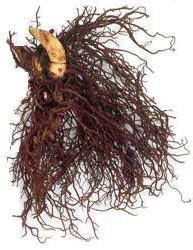
Rooting for coolness?
Investigators from the Mayo Clinic set out to determine whether menopausal flashers were better off using black cohosh root to treat the heat compared with no herbs at all.
132 hot women were assigned to try the supplement for 4 weeks followed by a month on fake cohosh. They all kept daily diaries (covered in hot pink no doubt) in which they scored each flash from 1-4 for severity. Total points for the fourth treatment and placebo weeks were compared to a baseline week prior to the study's start.
The average decrease in hot flash score was 20% for the week on black cohosh vs. 27% for the week on fake cohosh. This extraordinary placebo response has been noted in many other menopausal symptom treatment trials. Investigators concluded that black cohosh does not beat the postmenopausal heat.
I had one patient develop hepatitis as a result of using black cohosh. This side effect is uncommon but has been previously reported.
Tuesday, August 08, 2006
Delayed cell death

Brain injuries, traumatic, toxic, or ischemic (lack of blood flow due to stroke or aneurysm) cause immediate cell death that is unavoidable. A secondary wave of death occurs, however, when cells adjacent to the damaged site basically commit molecular hari-kari. This secondary die-off is called apoptosis which means 'fading away,' an unfortunate event occurring in healthy neurons exposed to inflmmation.
Researchers have found in animal experiments that estrogen "dramatically" protects against this delayed cell death in brain injury. Neurobiologists at the University of Kentucky began the investigation by removing the ovaries of 100 rats, plummeting the unsuspecting rodents into menopause.
They then gave half the rats low doses of estrogen. After one week, the rats were subjected to an 'experimental stroke' as the researchers cut off blood flow through a cerebral artery. While estrogen did not protect against the initial cell death that occurred within hours of the stroke, it did markedly reduce the secondary damage.
The scientists have identified the mechanism by which the hormone protects the brain. They hope to develop designer estrogens in the future that have purely protective actions without any detrimental effects on body tissues such as the breasts.
Subscribe to:
Posts (Atom)


